Lab Life

Connecting with the World, Deepening Learning with Colleagues

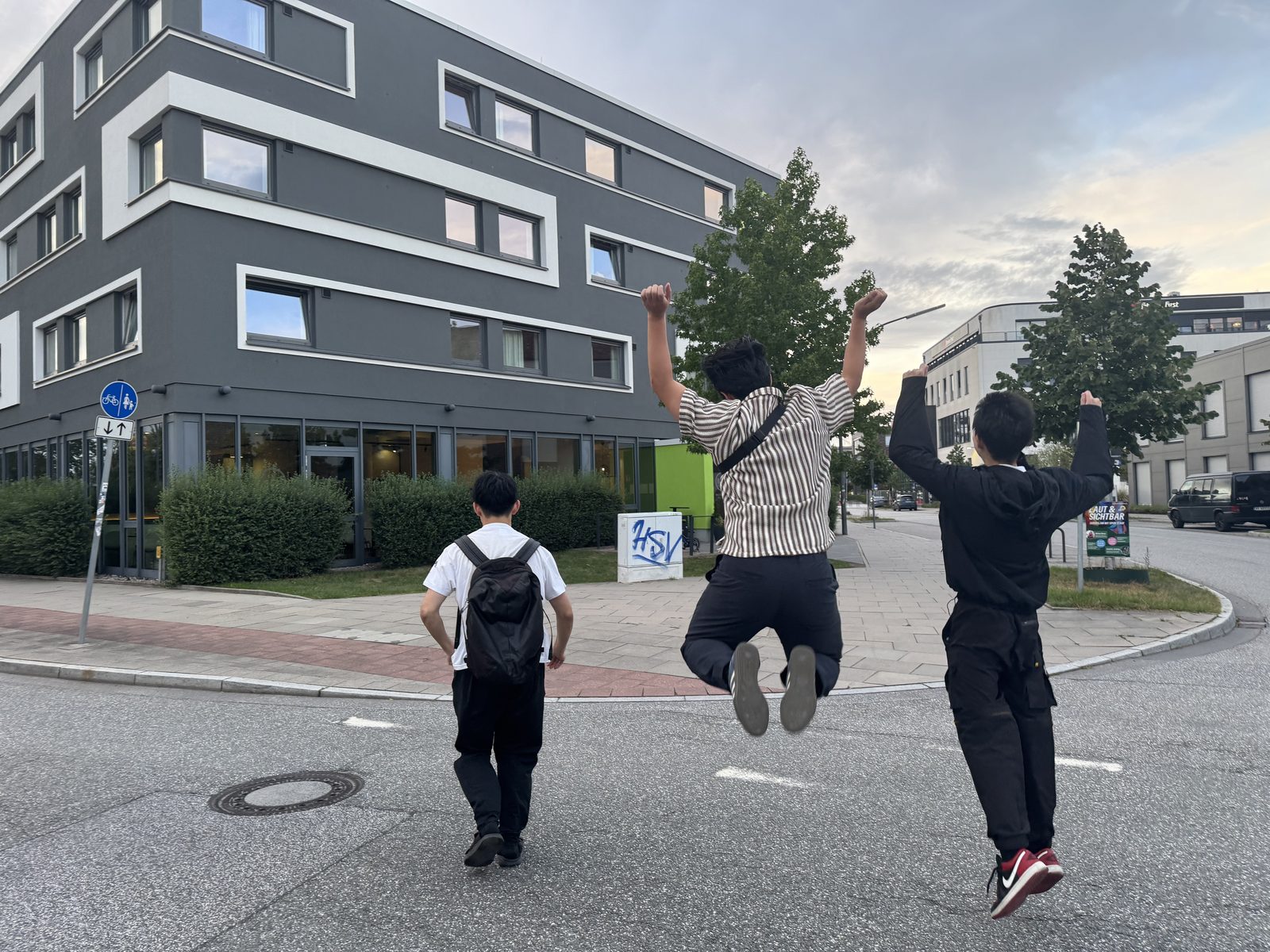
M1 members participating in the joint seminar of five universities at Hamburg University of Technology
2026.07.18 - 08.03

Joint Seminar of Five Universities, Hamburg University of Technology

Our M1 (first-year master's) students took part in a joint seminar hosted by Hamburg University of Technology (TUHH), Germany, bringing together five universities from around the world. They exchanged ideas on thermal engineering and human space design with students from many countries, gaining fresh perspectives through exposure to different cultures and research styles. Since returning, they have been applying the insights and connections gained there to their own research.
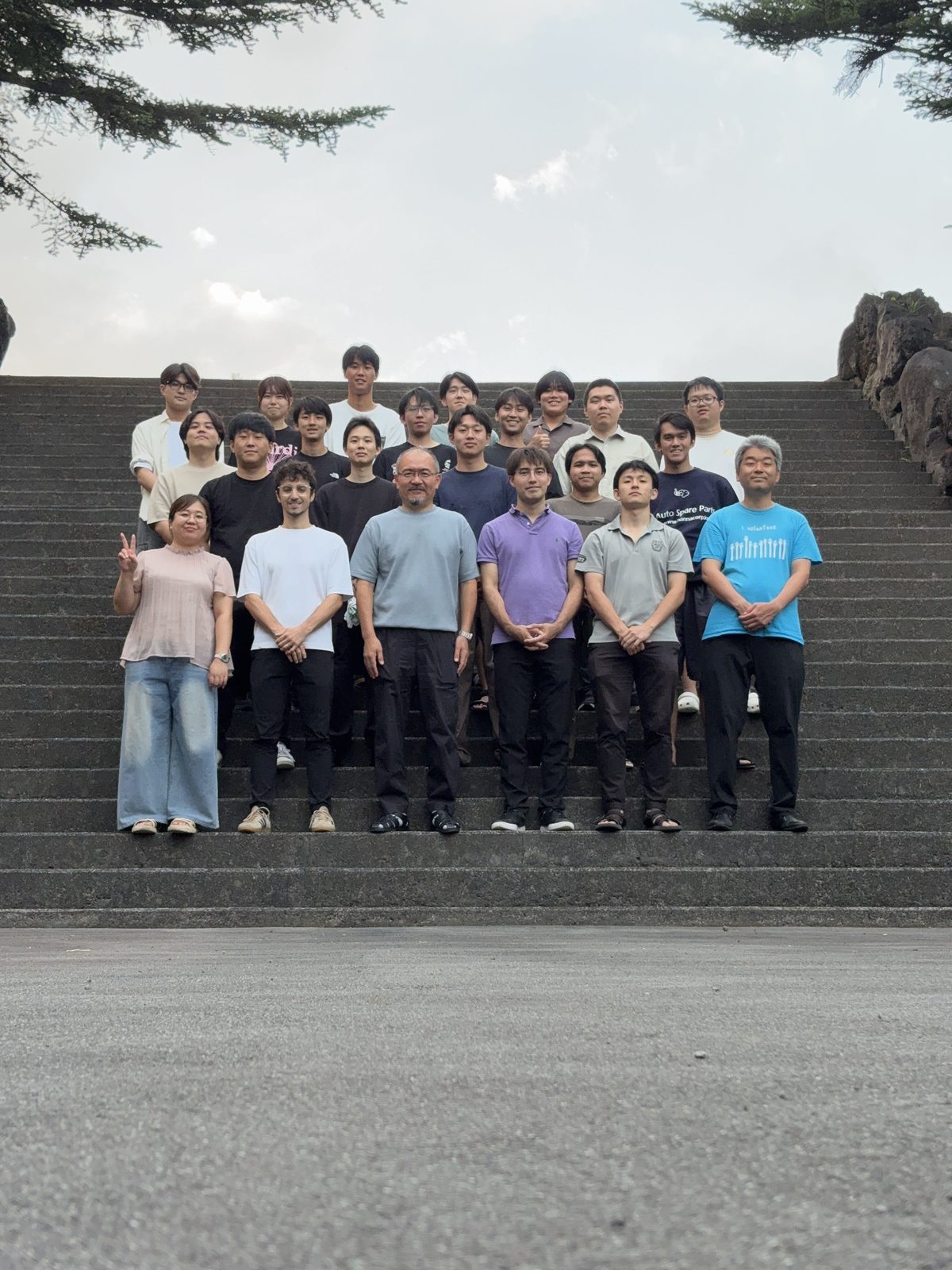
Group photo from the lab retreat at the Karuizawa Seminar House
2026.08.17 - 08.19

Lab Retreat at the Karuizawa Seminar House

We held our lab retreat at the Karuizawa Seminar House. M2 (second-year master's) students gave interim presentations and B4 (fourth-year undergraduate) students presented outlines of their graduation theses, sparking lively discussion of one another's research themes. In the evenings, everyone gathered around a barbecue to strengthen bonds, making for three days that balanced research with a chance to recharge.

The Lab in Three Minutes

Turning Classroom Learning into Living Wisdom

The research conducted in our laboratory is a natural extension of what students learn as undergraduates. In particular, the analogy-based and theory-based design methods taught in our course "Analytical Design Exercises in Engineering" become a powerful tool for designing complex human spaces as integrated systems. How do the equations and theories learned in lectures actually transform real-world spaces? Through hands-on practice in the lab, we help students elevate classroom knowledge into living wisdom they can put to use in society.

Scale & Global

An Overwhelming Scale of Facilities and a Global Research Environment

01

Hands-On Access to World-Class Experimental Facilities

Students operate our roughly JPY 600 million suite of cyber-physical facilities themselves, testing their own ideas instantly in "real space." Moving back and forth between simulation and physical experimentation builds genuinely practical skills.

02

An International Culture Born of Diversity

Outstanding international students and researchers gather here from around the world. Through everyday discussion, you naturally cultivate a global perspective and strong communication skills.

3 Skills

Three Capabilities You Will Develop Through Research

01

A Bird's-Eye View for Systems Design

Systems thinking that looks beyond individual component technologies (local optimization) to design the space as a whole (global optimization).

02

Cross-Disciplinary Expertise

The ability to build broad understanding of adjacent fields — information and control (AI, MPC), architecture, and energy — while grounding your core expertise in mechanical engineering (heat and fluids).

03

The Drive to Advance Projects on Uncharted Problems

The ability to independently run the full cycle of hypothesis, verification, and resolution when tackling unknown problems with no established answer.

Expectations

What the Saito Laboratory Expects of Its Students

Think, Create, and Act for Yourself

We cultivate a mindset that goes beyond simply learning existing knowledge — one that builds new spaces from the ground up. By combining architecture, mechanical engineering, information and control, and energy, you will develop the ability to unravel the complexities of heat transfer.

A Global Environment

Our lab has a very high proportion of students and researchers from overseas. You will take on large-scale research together with colleagues from around the world.
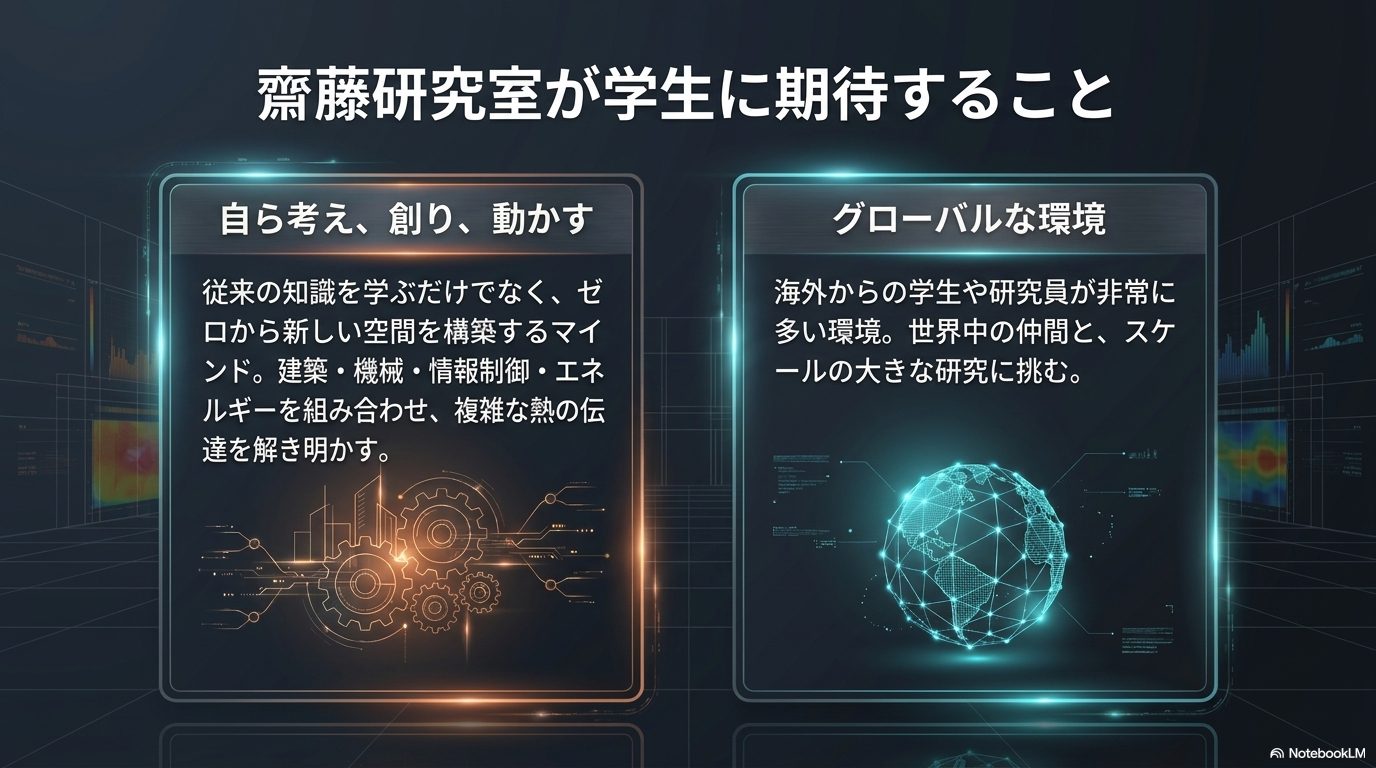
What the Saito Laboratory expects of its students

Lab Life

Through weekly seminars and events held throughout the year, we build a culture of sharing research progress and supporting one another.

  • Every Thursday morning: Student research progress meeting (seminar)
  • Three times a year: Interim presentations (B4, M1, M2)
  • Once a year: Annual final report meeting
  • Summer break: Karuizawa seminar retreat
  • M1: Participation in an international summer course

Support System

From launching a research theme through experiments, analysis, presenting results, and writing papers, our faculty, researchers, and senior students provide ongoing support. Regular research meetings keep everyone informed of progress and challenges, and provide a structure where students can always consult about the direction of their research.

Mentorship System

For each research theme, an assigned faculty member or researcher serves as a mentor to support the student's research activities. Students can consult their mentor day-to-day about planning, analysis methods, and any questions that arise in the course of research.
Voices

From Our Students and Alumni

Koharu Yokoo
M1

Koharu Yokoo

What I love about the Saito Laboratory is being able to see, first-hand, what approaches from the thermal field can effectively support a carbon-neutral society, and to feel how my own research and that of others in the lab contribute to society.

  • What I love about the Saito Laboratory is being able to see, first-hand, what approaches from the thermal field can effectively support a carbon-neutral society, and to feel how my own research and that of others in the lab contribute to society.
  • It's also great to be able to watch up close, with Professor Saito at the top, how the researchers actually carry out their work in the lab.
  • Air-conditioning equipment is itself a subject of our research — as a thermal-fluid machine that must be optimized for human comfort, it's a field with enormous room for further advancement, which is a big part of its appeal.
  • In the liquid desiccant team that I belong to, I get to run experiments and simulations with my own hands.
  • I have only run experiments so far, but by repairing the experimental equipment ourselves, we deepen our understanding of the very systems we are studying.

Coming Soon

We are preparing additional comments from students and alumni. Coming soon.

FAQ

Frequently Asked Questions

How busy is lab life?

It varies from person to person, and also depends on which research team you belong to.

  • How busy you feel varies a lot from person to person, and also depends on which research team you belong to. In the liquid desiccant team I'm part of, there's a two-hour team meeting once a week plus one lab-wide seminar per week.
  • During experiment periods, I sometimes spend an extra 5 or so hours a week on experiments, but during periods without experiments I may only put in about 2 hours of work a week.
  • As long as you're reachable during core hours (9:00 a.m. to 5:00 p.m.), there's no problem.
  • Most students who work part-time jobs do so in the evenings (often night shifts, roughly once a week), and some also serve as teaching assistants for courses such as Analytical Design Exercises in Engineering, Thermodynamics, and Control Engineering.
  • How busy things feel can vary quite a bit depending on your year and the time of year.
  • B4 and M2 students are busy from October through January because of their bachelor's and master's theses, and generally can't take classes during that period. M1 students tend to get busy from around May with internships and similar activities.

Do I need English ability?

It's an advantage to have it, but comprehension and communication skills in Japanese matter more.

  • It's an advantage to have English ability. Many faculty members and students at the Saito Laboratory, starting with Professor Niccolò, come from overseas.
  • English ability helps you communicate smoothly and deepen your learning by reading papers, but I feel it's more important to firmly understand your own and others' research in Japanese, and to have solid communication skills in general.
  • Students who wish to can take part in a two-week program in M1 together with students from four overseas universities, so it helps to be able to speak confidently in English about your B4 graduation research beforehand — it will make the program much more enjoyable.

What skills do I need before joining the lab?

Being comfortable using Word, Excel, and PowerPoint is enough.

  • Being comfortable using Word, Excel, PowerPoint, and similar tools is enough. Every research team gives a results presentation using PowerPoint, Excel, and the like once a week within the team, and there's a lab-wide results presentation once a month.
  • Of course, doing your research diligently matters, but being good at "presenting" your work well is also important.
  • It's a plus if you can use tools like MATLAB or Python, but you can build those skills from scratch after joining.
  • Having a solid grasp of required department courses such as thermodynamics and fluid mechanics makes it much easier to understand your research topic.

How are research themes decided?

You choose from the lab's existing themes, and assignments are made based on your ranked preferences.

  • In general, you choose the theme you want from among the lab's existing themes, and assignments are made based on ranked preferences.
  • Also, when the lab takes on new research, your theme may change if you have a research interest of your own, or prior research experience, that relates to the new work.

Feel Free to Visit or Consult with Us

We're happy to talk with you directly about the atmosphere of the lab and about choosing a research theme.